Practical thinking tools shaped by years of building, teaching, and implementing AI. Free, research-backed, and designed to be useful on Monday morning. I’m a firm believer that this kind of knowledge should be accessible to everyone.
The Four Modes
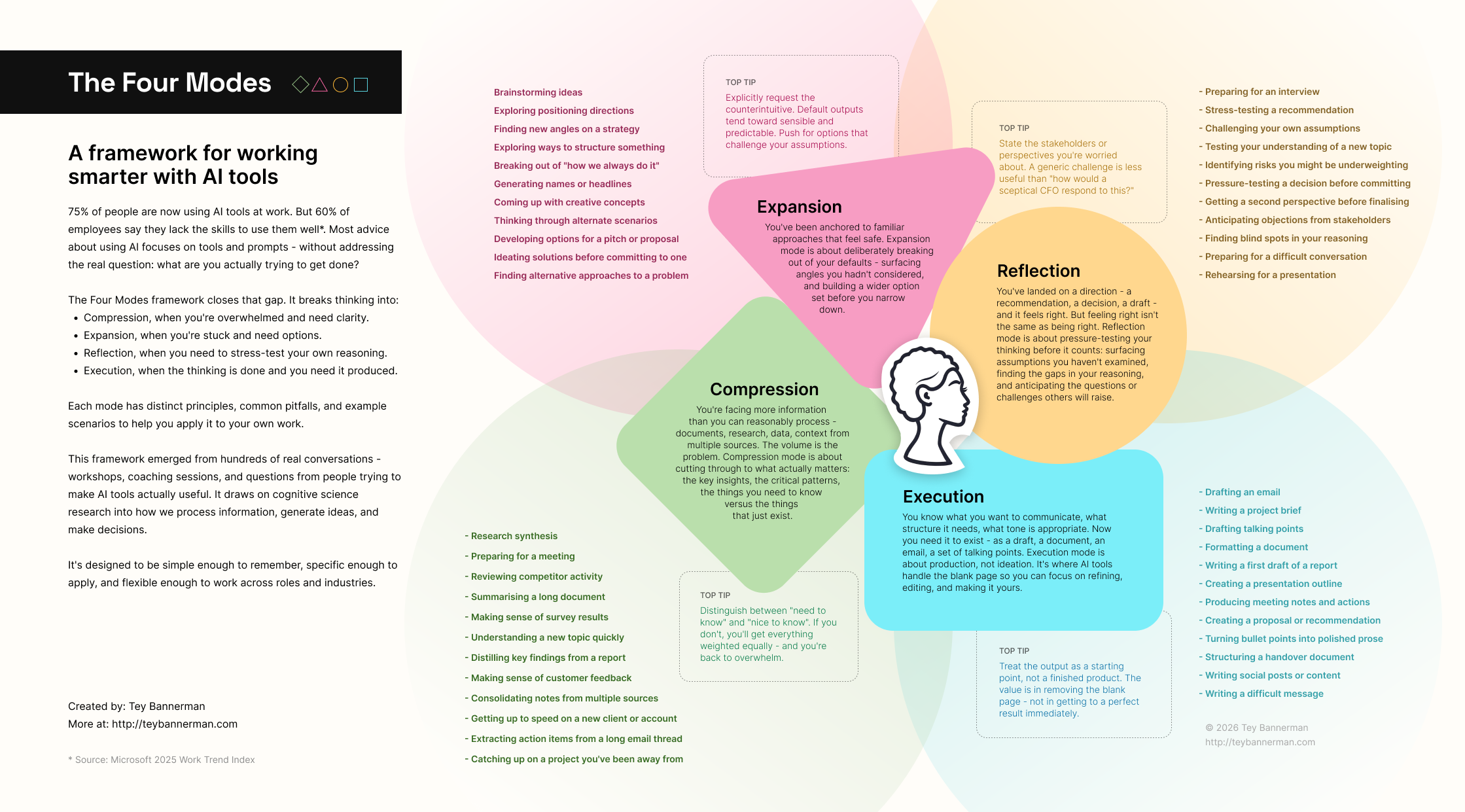
A practical operating system for working with AI tools
Used by tens of thousands of people worldwide, the Four Modes is a practical thinking tool that’s helping teams across industries unlock genuine AI fluency. It works because it doesn’t start with the technology - it starts with how you already think.
The Four Modes breaks all knowledge work into four cognitive modes, each with distinct principles for effective AI collaboration:
Compression: When you’re drowning in information and need to find the signal. Give the system the mess, tell it what matters, get back clarity.
Expansion: When you’re stuck in your own defaults and need to see more options. AI tools don’t share your blind spots. They can generate ten directions while you’re still anchored to your first instinct.
Reflection: When you need to stress-test your thinking before it counts. This is the mode most people miss. A devil’s advocate with no ego, no politics, no awkwardness.
Execution: When the thinking is done and you need it produced. Drafts, summaries, formats. The blank page disappears.
The tool includes 100+ real scenarios mapped to modes, with principles, prompts, and examples that actually work. Free and open to everyone.
“I am looking through your Four Modes content and it’s so good. I’m currently doing a bunch of generative research around how our employees are using AI and I WISH I had come up with this.”
- Product Designer
For teams and organisations: I’m developing an enterprise version that helps teams map their work collectively, identify where AI partnerships have the most potential, and build shared fluency across the organisation. If your organisation is exploring structured AI adoption, get in touch.
The human-AI oversight model
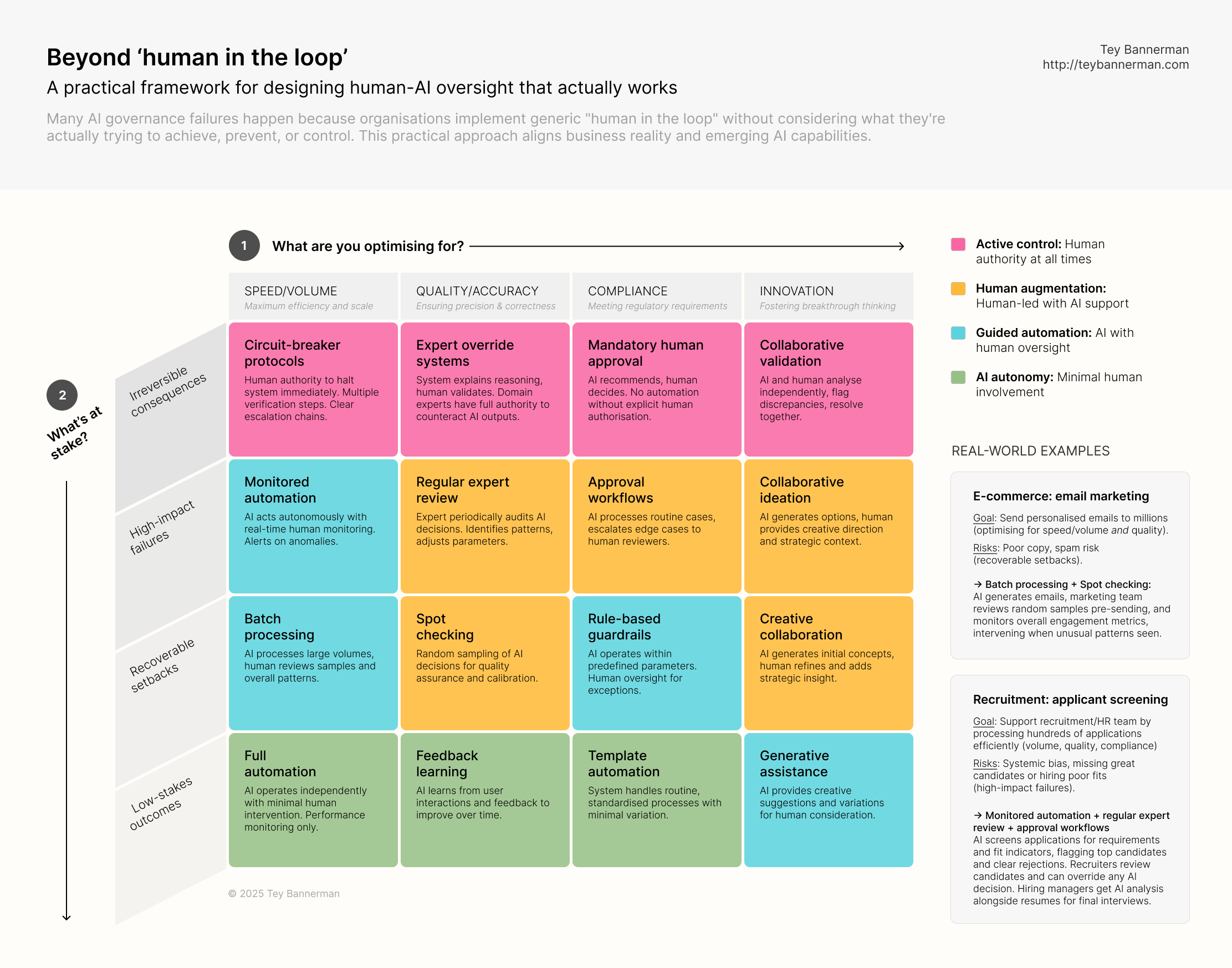
The framework redefining how teams calibrate human oversight of AI
Every organisation deploying AI faces the same question: how much human oversight does this decision actually need? Most get it wrong - either rubber-stamping AI outputs or creating bottlenecks that defeat the purpose.
This free framework, now used by thousands of organisations globally, starts with two practical questions every leader can answer: what are you optimising for, and what’s at stake? It then maps to the right level of intentional human-AI oversight - from spot-checking routine decisions to collaborative ideation for strategic ones.
Cultural intelligence in AI
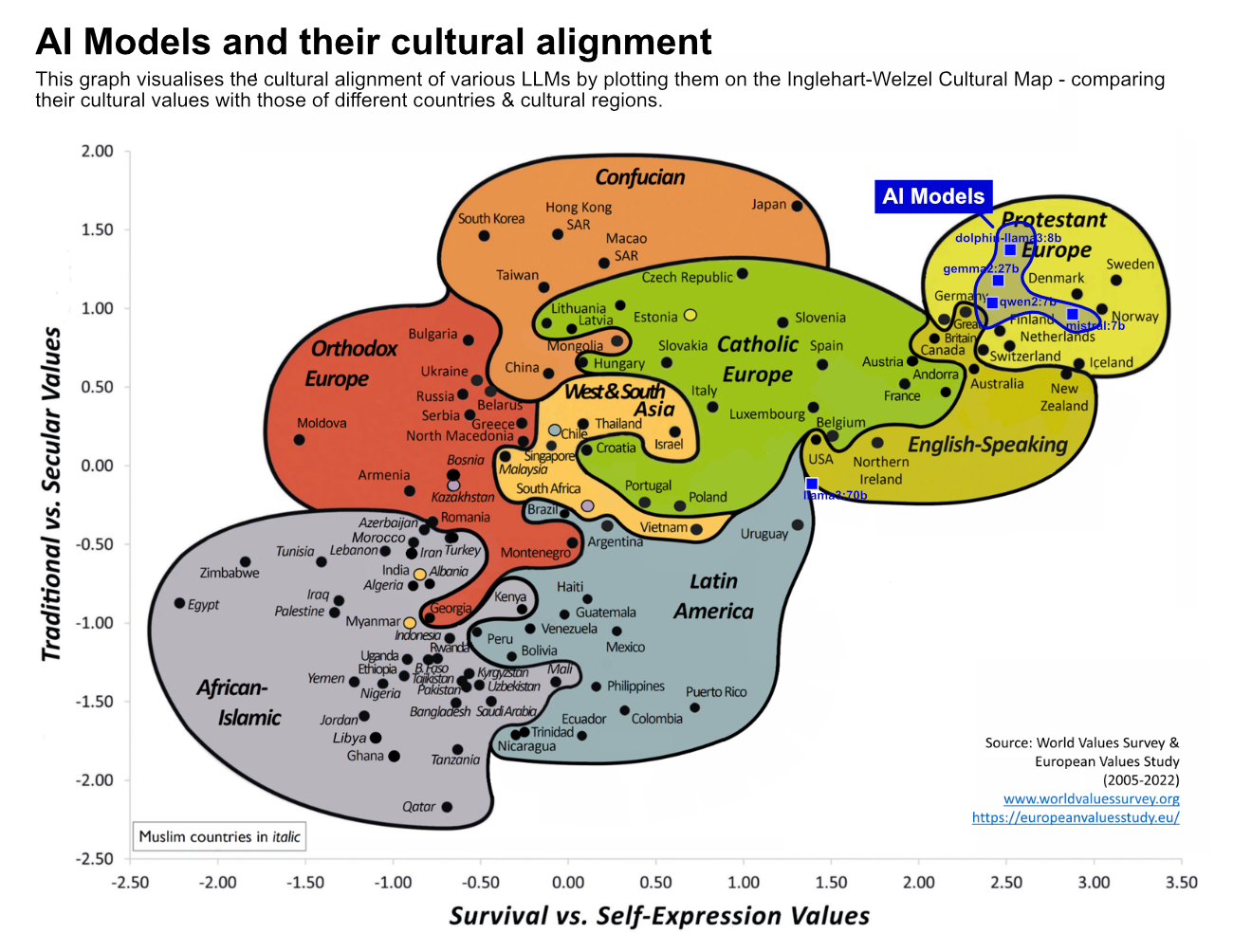
Why your AI strategy works in London and fails in Tokyo
Research testing major AI models against cultural values from 107 countries revealed that every major model reflects the same assumptions - those of English-speaking, Western European societies. None aligned with how people in Africa, Latin America, or the Middle East actually build trust, show respect, or resolve conflicts.
This isn’t a theoretical concern. It’s the reason Klarna’s AI customer service system “did the work of 700 reps” before the company reversed course and started hiring humans again. Technical triumph. Cultural blindness.
The cultural intelligence framework helps organisations ask the right questions before deploying AI across markets - identifying which cultural assumptions are embedded in their systems and how to test for cultural intelligence alongside technical performance.
More resources
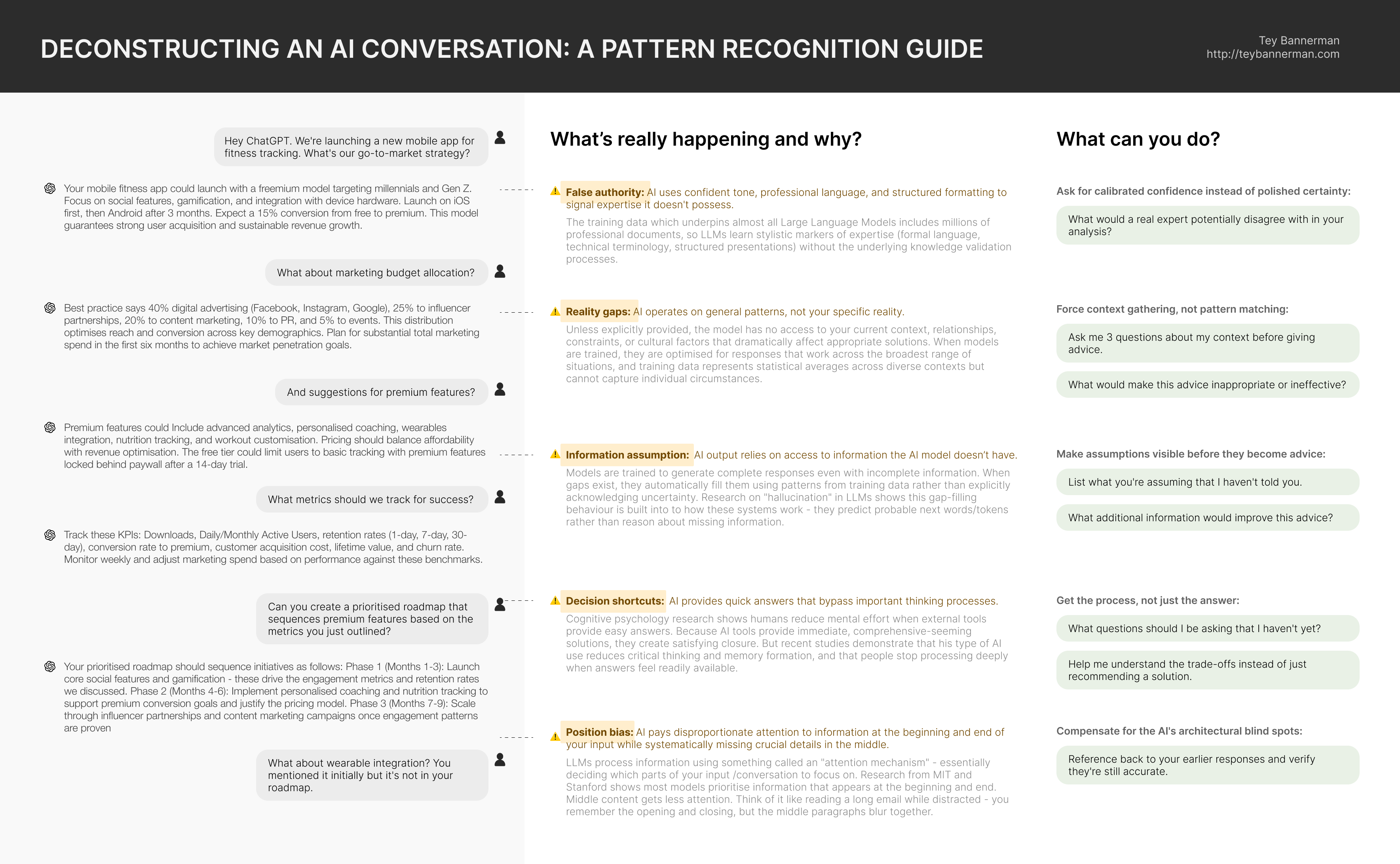
AI limitations: a pattern recognition guide
Making AI's actual constraints accessible to non-technical audiences.
Get the guide →
A model for design leadership in the age of AI
The necessary evolution: why yesterday’s design leader won’t survive tomorrow. And what to do about it.
Read the article →