The four modes: a framework for working with AI tools
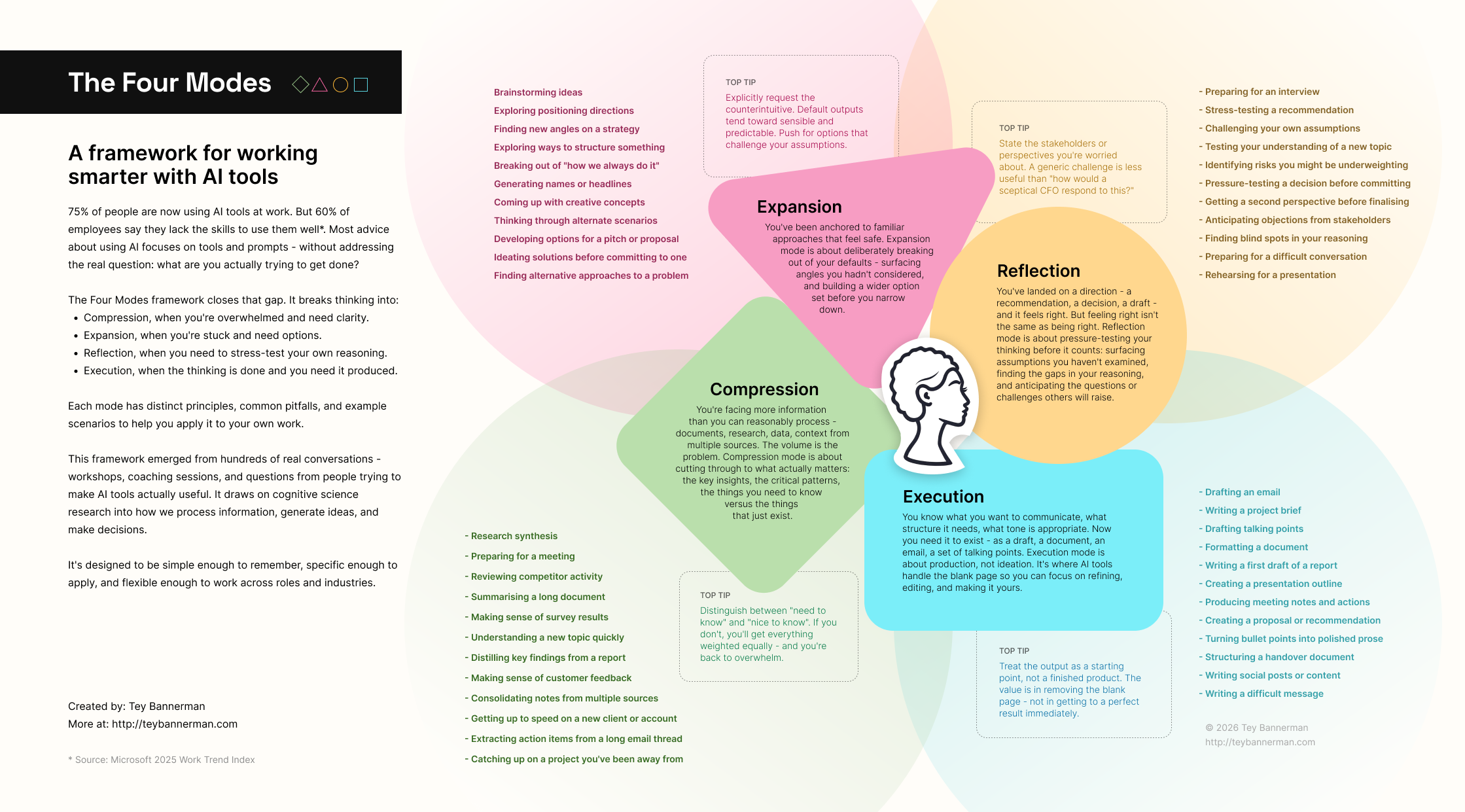
Download the PDF: four-modes-of-working-with-ai.pdf
Explore the scenarios: https://fourmodes.teybannerman.com
Over the last year, I’ve kept a running note on my phone. Every time someone asked me about using AI tools for a task, I wrote it down.
As the list grew, I started noticing something. The surface questions were all different - “How do I summarise this?” “What’s a good prompt for writing emails?” But underneath, the same struggles kept repeating. People overwhelmed by information and unsure what mattered. People who knew what they wanted to say but couldn’t get it out of their heads. The tasks varied. The sticking points didn’t.
For a while, I thought the answer was better prompts. Teach people the right words, the right structure, and they’d get better results.
I was wrong.
Prompts are useful once you know what you need - and completely useless if you don’t. We’ve been teaching people the grammar of prompting without the vocabulary of thinking.
Think about it - when you sit down to work, you don’t consciously label what you’re doing. You just… do it. Check emails. Prep for a meeting. Make a decision. Write a doc. It’s all just “work”.
But when I looked at that list again - all those questions, all those struggles - I could see them sorting themselves into four distinct buckets. Four modes of thinking. Each one with its own logic, its own pitfalls, and its own way that AI tools can actually help:
♢ Compression - when you’re drowning in information and need to find the signal. Give it the mess, tell it what matters, get back clarity.
△ Expansion - when you’re stuck in your own defaults and need to see more options. AI tools don’t have your blind spots. They can generate ten directions while you’re still anchored to your first instinct.
Ⓞ Reflection - when you need to stress-test your thinking before it counts. This is the mode people miss most. A devil’s advocate with no ego, no politics, no awkwardness.
🔲 Execution - when the thinking is done and you just need it produced. Drafts, summaries, formats. The blank page disappears.
I’ve spent the last couple of months battle-testing this framework with teams across industries - from finance to fashion to government, and the feedback has been immense. It works because it’s not really about AI. It’s about understanding your own thinking.
And now I’ve taken that running note - over 100 real scenarios - and built it into a handy tool, free for anyone and everyone to use. I genuinely believe this type of info should be freely available - not behind paywalls and email capture forms.
Here’s the link: https://fourmodes.teybannerman.com
Find your task. See which mode it falls into. Get prompts, principles, and examples that actually work.
If it’s useful, share it with someone you think would benefit. And if you use it and discover something - a missing scenario, a mode that clicked, a result that surprised you - I’d genuinely love to hear it.
Let’s spread the knowledge. ✌️