<?xml version="1.0" encoding="utf-8"?><feed xmlns="http://www.w3.org/2005/Atom" ><generator uri="https://jekyllrb.com/" version="3.10.0">Jekyll</generator><link href="https://teybannerman.github.io/feed.xml" rel="self" type="application/atom+xml" /><link href="https://teybannerman.github.io/" rel="alternate" type="text/html" /><updated>2026-06-29T16:33:59+00:00</updated><id>https://teybannerman.github.io/feed.xml</id><title type="html">Tey Bannerman</title><subtitle>Practical intelligence for the AI era</subtitle><author><name>Tey Bannerman</name><email>tey.bannerman@gmail.com</email></author><entry><title type="html">How many products does Microsoft have named ‘Copilot’? I mapped every one</title><link href="https://teybannerman.github.io/strategy/2026/03/31/how-many-microsoft-copilot-are-there.html" rel="alternate" type="text/html" title="How many products does Microsoft have named ‘Copilot’? I mapped every one" /><published>2026-03-31T02:00:00+00:00</published><updated>2026-03-31T02:00:00+00:00</updated><id>https://teybannerman.github.io/strategy/2026/03/31/how-many-microsoft-copilot-are-there</id><content type="html" xml:base="https://teybannerman.github.io/strategy/2026/03/31/how-many-microsoft-copilot-are-there.html"><![CDATA[<div style="background: #f2f2f0; border-radius: 5px; padding: 18px 20px; margin-bottom: 12px; font-size: 0.88rem;">
<strong>Update (9 Apr 2026):</strong> Another one. A helpful person sent in <a href="https://adoption.microsoft.com/en-us/copilot/us-government/">Microsoft 365 Copilot for US Government</a>. That's 81. Chart updated.
</div>

<div style="background: #f2f2f0; border-radius: 5px; padding: 18px 20px; margin-bottom: 28px; font-size: 0.88rem;">
<strong>Update (5 Apr 2026):</strong> Since this was published, the lovely internet community has let me know we were missing two Copilots: <a href="https://news.xbox.com/en-us/2025/09/18/gaming-copilot-xbox-pc-mobile/">Gaming Copilot</a> and <a href="https://www.microsoft.com/en-us/health-solutions/clinical-workflow/dragon-copilot">Microsoft Dragon Copilot</a> (🤦‍♀️). This brings the total to 80. The chart has been updated and I'll continue to update it as Microsoft continues to Copilot.
</div>

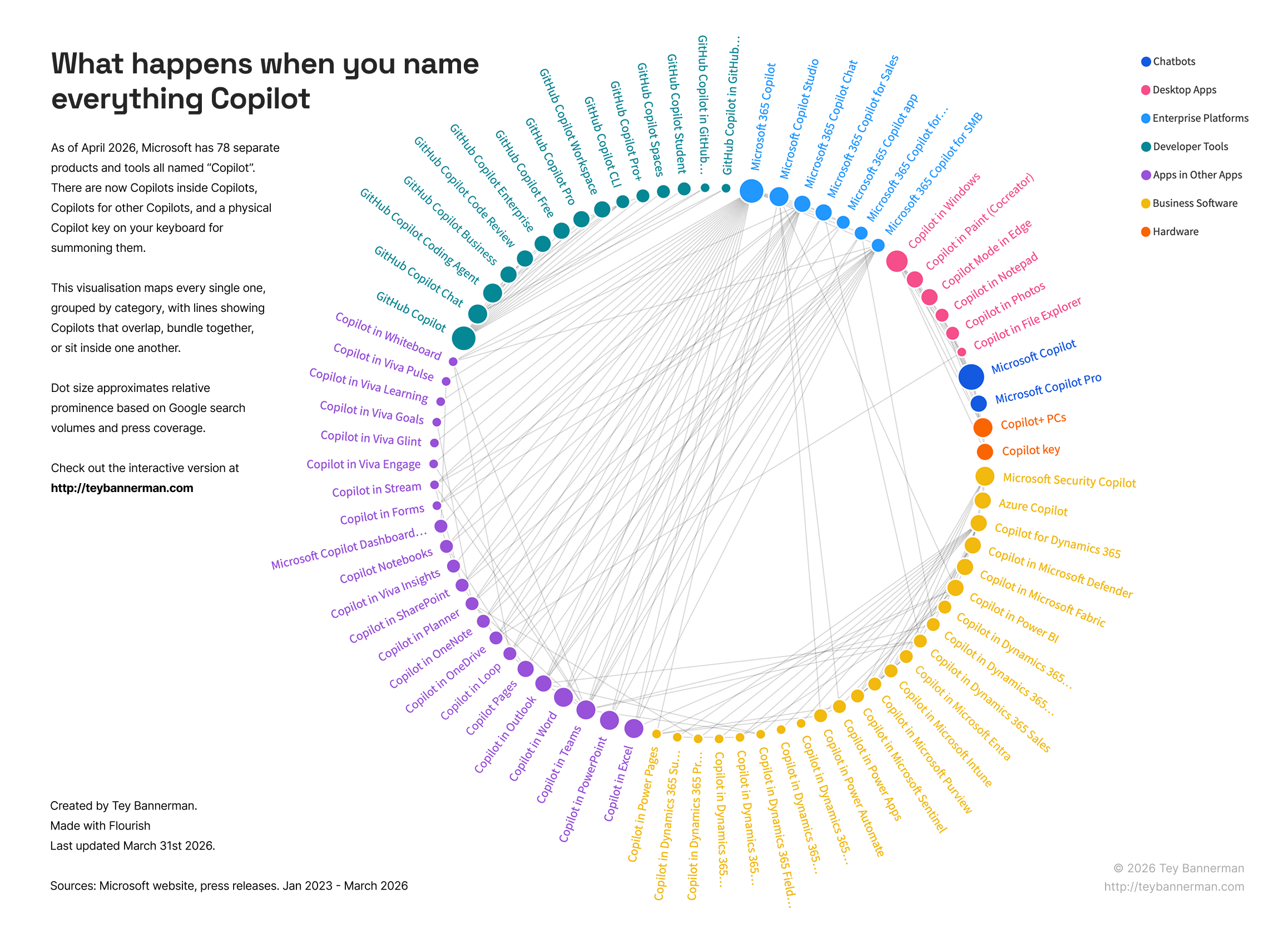
<p>A few weeks ago, I tried to explain to someone what Microsoft Copilot is. I couldn’t… because the name ‘Copilot’ now refers to at least 75 different things.</p>

<p>Apps, features, platforms, a keyboard key, an entire category of laptops - and a tool for building more Copilots. All named ‘Copilot’.</p>

<p>I went looking for the full list. No single source had all of them. Not even Microsoft’s own website or documentation. So I pieced it together from product pages, launch announcements, and marketing materials.</p>

<p>The visualisation below maps every one, grouped by category, with lines showing how they connect. It’s interactive - click around. Try to find a pattern. I couldn’t.</p>

<p>-</p>

<div class="visualization" style="height: 980px; border: 0; padding: 0;">
	<div class="flourish-embed flourish-chart" data-src="visualisation/28304418?3022273"><script src="https://public.flourish.studio/resources/embed.js"></script><noscript><img src="https://public.flourish.studio/visualisation/28304418/thumbnail" width="100%" alt="visualization" /></noscript></div>
</div>

<p>-</p>

<table>
  <tbody>
    <tr>
      <td>Visualisation created with <a href="https://flourish.studio/">Flourish</a></td>
      <td><a href="/images/microsoft-copilot-chart-infographic-by-teybannerman.png">Image download</a></td>
    </tr>
  </tbody>
</table>]]></content><author><name>Tey Bannerman</name><email>tey.bannerman@gmail.com</email></author><category term="strategy" /><summary type="html"><![CDATA[Update (9 Apr 2026): Another one. A helpful person sent in Microsoft 365 Copilot for US Government. That's 81. Chart updated.]]></summary></entry><entry><title type="html">The Jesusification of AI</title><link href="https://teybannerman.github.io/ai/2026/03/06/the-jesusification-of-ai.html" rel="alternate" type="text/html" title="The Jesusification of AI" /><published>2026-03-06T02:00:00+00:00</published><updated>2026-03-06T02:00:00+00:00</updated><id>https://teybannerman.github.io/ai/2026/03/06/the-jesusification-of-ai</id><content type="html" xml:base="https://teybannerman.github.io/ai/2026/03/06/the-jesusification-of-ai.html"><![CDATA[<p><img src="/images/the-jesusification-of-ai-bannerman.jpg" alt="'The Jesusificatio of AI' by Tey Bannerman" />
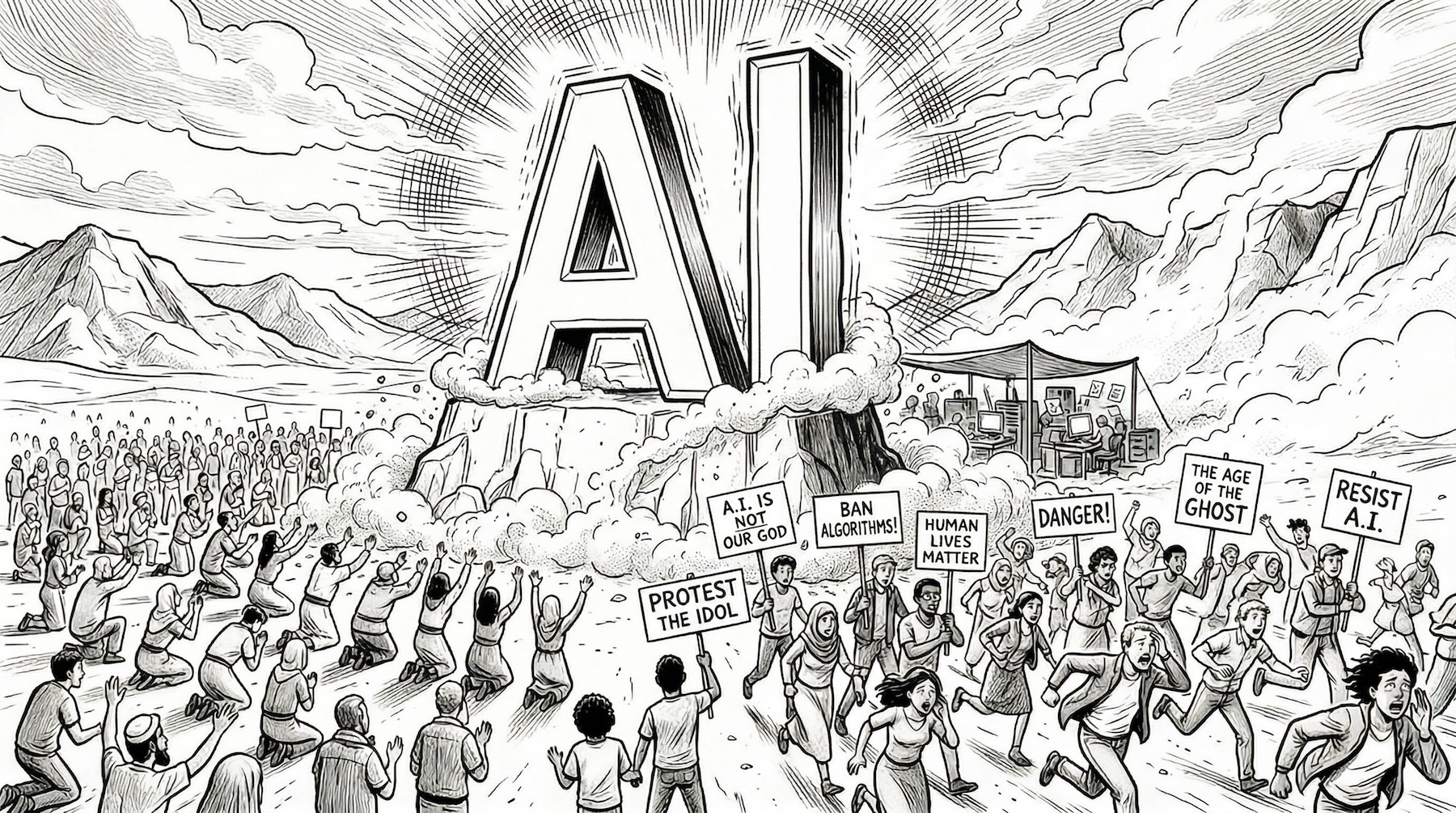
<em>Image created with Google Nano Banana 2 and edited with Freepik</em></p>

<p>The Bible’s Book of Exodus contains one of the sharpest observations about human nature ever written. It goes like this:</p>

<p>Moses, the man leading an entire people to a new homeland, climbs a mountain to receive the laws that will shape their future. And then he’s gone. Days pass. Weeks. No updates. No timeline. No indication of when - or whether - he’s coming back.</p>

<p>Imagine the anxiety. Your leader has disappeared. The future he promised is invisible. You have no information, no control, and no idea what happens next.</p>

<p>So the people do something deeply human. They decide that if the future won’t reveal itself, they’ll build something to believe in instead. Something they can see, something they can touch - something that makes the invisible feel manageable. They gather their gold, melt it down, and build an idol - a golden calf. A single, tangible “thing” they can point to and organise their anxiety around.</p>

<p>The golden calf wasn’t a god, though. It was a projection surface. A place to put fear and hope when the future felt unknowable.</p>

<p>I think we’re doing it again.</p>

<p>“AI will take your job”.<br />
“That looks like it was written by AI”.<br />
“I used AI to plan my holiday”.<br />
“AI is going to destroy creativity”.</p>

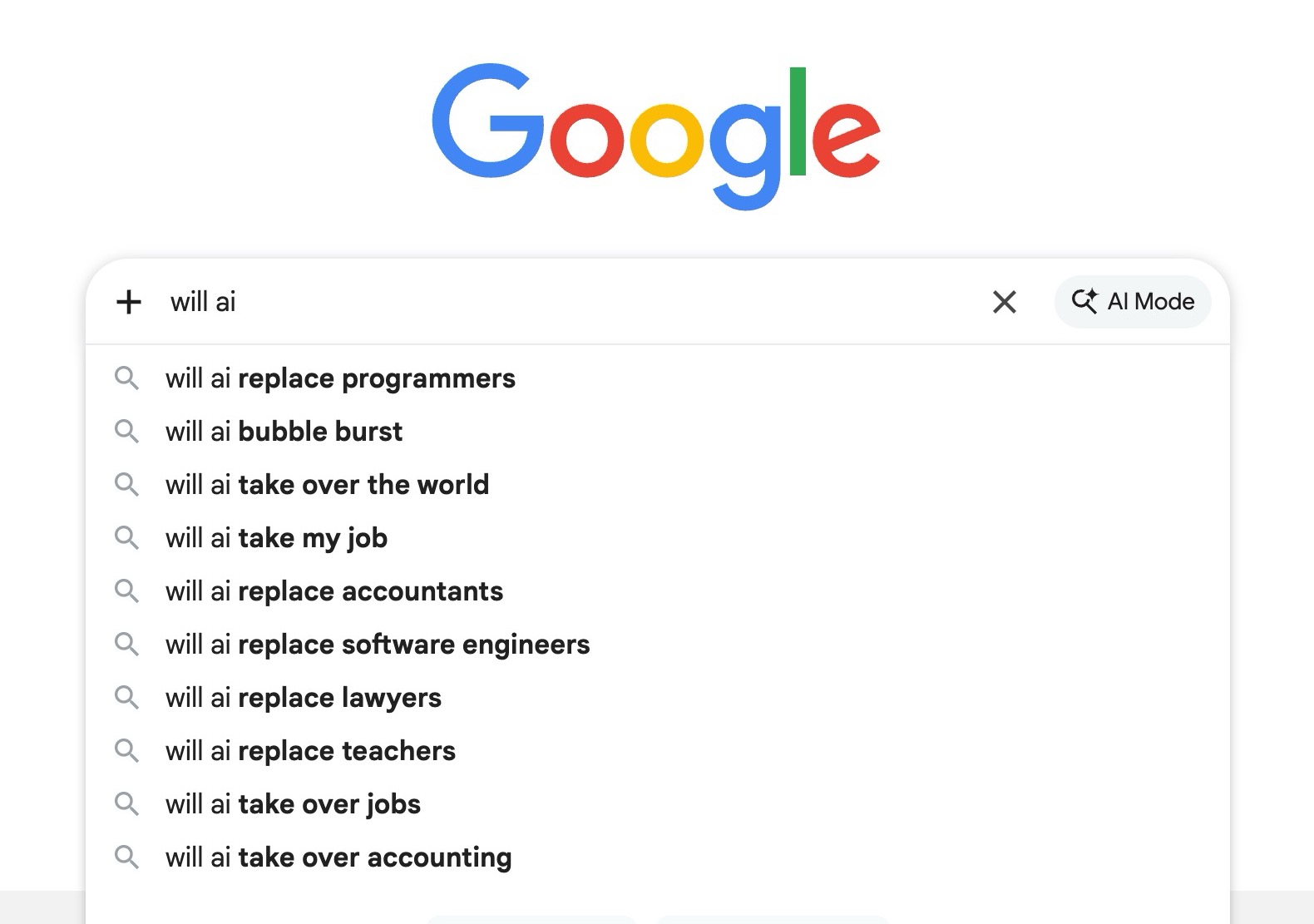
<p><img src="/images/will-ai-google-search-2026-03.jpg" alt="'Google search suggestions for &quot;will ai&quot;, March 2026'" />
<em>Google search suggestions for “will ai”, March 2026</em></p>

<p>Listen to how we talk. We’ve turned “AI” into something almost religious - a single, gleaming word onto which we project hopes, anxieties, and predictions about the future. I’ve started calling it <strong>the Jesusification of AI</strong>. We worship it or we fear it - but either way, we talk about it as though it’s one thing. A singular force. An entity with intentions.</p>

<p>It isn’t.</p>

<p>What we call “AI” is dozens of distinct technologies that work in fundamentally different ways.</p>

<p>When your phone predicts the next word you’re about to type.<br />
When Spotify auto-plays a song that becomes the soundtrack to your year.<br />
When your Apple Watch shows you your health metrics.<br />
When a doctor catches a tumour early because a diagnostic model flagged an anomaly smaller than a grain of rice.</p>

<p>All of these are “AI”. But they’re all built differently, they work differently, and they have completely different implications for your life.</p>

<p>But we’ve melted them all down into one golden word. And that collapse is doing real damage…</p>

<p><strong>It’s making us afraid of the wrong things.</strong></p>

<p>“AI will take your job” was one of the most repeated sentences of 2025. But it’s so vague it’s almost meaningless. Which technology? In what role? Replacing which specific tasks? Augmenting which others?</p>

<p>A friend of mine - a graphic designer - spent months in genuine career anxiety because “AI is replacing designers”. When we actually sat down and talked through his work, it turned out that generative image models could handle roughly 15% of what he does - producing initial concept variations - while being essentially useless for the other 85%: understanding client politics, navigating brand strategy, making judgment calls about cultural context, building relationships. His fear wasn’t proportionate to the reality. But “AI is replacing designers” doesn’t leave room for that nuance.</p>

<p>Multiply that by millions of people, and the result is a kind of quiet collective hallucination - not in the dramatic, dystopian sense, but in the everyday sense of millions of people forming strong opinions about a thing that doesn’t actually exist as a single thing.</p>

<p>“Will AI take our jobs”? Depends entirely on which technology, which tasks, which industries, what timeline. But the golden-word framing forces a binary answer: yes or no. And binary answers to complex questions aren’t just unhelpful - they’re paralysing.</p>

<p><strong>It’s making us trust the wrong things.</strong></p>

<p>Then there’s the opposite problem: misplaced faith.</p>

<p>A friend told me recently that he’d typed his chest pain symptoms into ChatGPT. He described the response the way you’d describe a doctor’s reassurance - casually, settled. But the tool that had put his mind at ease hadn’t examined him, didn’t know about his current prescriptions, and had no awareness of the respiratory virus spreading through his child’s school. It had generated a confident sequence of words. But “using AI” made that interaction feel like consulting an authority. In reality, it was closer to asking a very well-read stranger on a bus.</p>

<p>A recruiter friend described the mirror image. She’s drowning in cover letters that are polished, well-structured… and completely pointless. Candidates think they’ve found a shortcut to sounding impressive. They’ve actually found a shortcut to sounding like every other applicant who found the same shortcut. None of them stopped to think about who would read this cover letter, what that person sees hundreds of times a day, and whether the tool they’d trusted had any idea about either.</p>

<p>In both cases, the technology did exactly what it was designed to do. The trust failure isn’t in the systems - it’s in a label that tells people, “this is intelligent” before they’ve asked, “at what?”. “AI” projects a blanket authority that flattens every tool into one. A person can’t calibrate their trust appropriately when the same two letters describe a text generator and a cancer detection model. So they don’t calibrate at all. They just trust - or don’t - based on how they feel about the monolith.</p>

<p><strong>It’s making us passive when we should be curious.</strong></p>

<p>This might be the biggest cost of all.</p>

<p>When “AI” becomes a monolith - a single, all-powerful force - it starts to feel like something that happens to you. Something you can’t understand, can’t influence, and certainly can’t shape. It creates a sense of helplessness that isn’t justified.</p>

<p>When you’re told “AI is reshaping the economy”, what can you do? It sounds like the weather - vast, impersonal, beyond influence.</p>

<p>But that framing is a lie. Every tool and technology that gets called “AI” is the product of hundreds of human decisions. A team chose a specific model architecture, trained it on specific data with specific objectives, and deployed it in a specific context with specific trade-offs.</p>

<p>Humans made every one of those choices. They could have chosen differently. And when you interact with these systems - when you use them, when you’re affected by them, when you pay for them - you’re not standing before an unknowable force. You’re using something that was designed, that has assumptions baked in, and that responds to pressure from the people who use it.</p>

<p><strong>The way out is simpler than you think.</strong></p>

<p>Here’s what I find encouraging. You already have the skill this requires.</p>

<p>When a doctor suggests a treatment, you don’t nod and accept it. You ask questions. What kind of treatment? What are the side effects? What’s the recovery like? Are there alternatives? You don’t worship medicine as a monolith. You engage with it specifically.</p>

<p>We’re perfectly capable of this kind of thinking. We just haven’t applied it here yet.</p>

<p>The people at the bottom of the mountain didn’t need to understand how the calf was built to stop worshipping it. They needed to recognise it for what it was: gold that had been shaped by hands, from materials, with choices. Something made. Something that could be questioned.</p>

<p>When someone says “AI is going to replace teachers”, ask: which tool? Doing what part of teaching? The lesson planning? The emotional support when a student is struggling? The ability to notice that a child who’s usually engaged has gone quiet for three days? Which part, specifically?</p>

<p>When you use one of these tools, test its limitations in your own context. Lie to it (seriously). Give it false information and see if you get pushback or if it happily builds on the fiction. That thirty-second experiment will teach you more about what you’re actually dealing with than a year of headlines.</p>

<p>Because behind every one of these tools is a company that wants your attention, your trust, and your money. They have support teams, feedback loops, and commercial incentives. You can push back. You can leave. You can choose competitors that are more honest, more reliable, or simply better for the thing you’re trying to do. You have more influence over these systems than the word “AI” will ever let you feel.</p>

<p>None of this requires expertise. It requires the willingness to stop projecting and start asking.</p>

<p><strong>What the calf was always about</strong></p>

<p>The golden calf was never about the calf. It was about needing certainty when the future felt unknowable. Something solid to point to when everything else was shifting.</p>

<p>That’s understandable. The pace of technological change right now is genuinely disorienting. Wanting a simple frame - something to worship or something to blame - is one of the most human responses there is.</p>

<p>But the cost of that simplicity is agency. As long as “AI” remains a golden idol - all-powerful, singular, beyond questioning - we remain worshippers or fearers rather than participants.</p>

<p>But every time you ask, “which system are we actually talking about?”, every time you double-check an output, every time you make the choice to switch to another tool, you’re reclaiming something the monolith took from you: the understanding that this isn’t a force. It’s a collection of technologies and tools, built by people, that you have every right to question.</p>

<p>The future doesn’t need our worship. It needs us to be specific.</p>]]></content><author><name>Tey Bannerman</name><email>tey.bannerman@gmail.com</email></author><category term="ai" /><summary type="html"><![CDATA[Image created with Google Nano Banana 2 and edited with Freepik]]></summary></entry><entry><title type="html">The four modes: a framework for working with AI tools</title><link href="https://teybannerman.github.io/ai/framework/2026/02/25/four-modes-of-thinking-ai.html" rel="alternate" type="text/html" title="The four modes: a framework for working with AI tools" /><published>2026-02-25T02:00:00+00:00</published><updated>2026-02-25T02:00:00+00:00</updated><id>https://teybannerman.github.io/ai/framework/2026/02/25/four-modes-of-thinking-ai</id><content type="html" xml:base="https://teybannerman.github.io/ai/framework/2026/02/25/four-modes-of-thinking-ai.html"><![CDATA[<p><img src="/images/four-modes-of-working-with-ai.png" alt="Four Modes of Thinking Framework by Tey Bannerman" /></p>

<p>Download the PDF: <a href="/images/four-modes-of-working-with-ai.pdf">four-modes-of-working-with-ai.pdf</a></p>

<p>Explore the scenarios: <a href="https://fourmodes.teybannerman.com">https://fourmodes.teybannerman.com</a></p>

<p>Over the last year, I’ve kept a running note on my phone. Every time someone asked me about using AI tools for a task, I wrote it down.</p>

<p>As the list grew, I started noticing something. The surface questions were all different - “How do I summarise this?” “What’s a good prompt for writing emails?” But underneath, the same struggles kept repeating. People overwhelmed by information and unsure what mattered. People who knew what they wanted to say but couldn’t get it out of their heads. The tasks varied. The sticking points didn’t.</p>

<p>For a while, I thought the answer was better prompts. Teach people the right words, the right structure, and they’d get better results.</p>

<p>I was wrong.</p>

<p>Prompts are useful once you know what you need - and completely useless if you don’t. We’ve been teaching people the grammar of prompting without the vocabulary of thinking.</p>

<p>Think about it - when you sit down to work, you don’t consciously label what you’re doing. You just… do it. Check emails. Prep for a meeting. Make a decision. Write a doc. It’s all just “work”.</p>

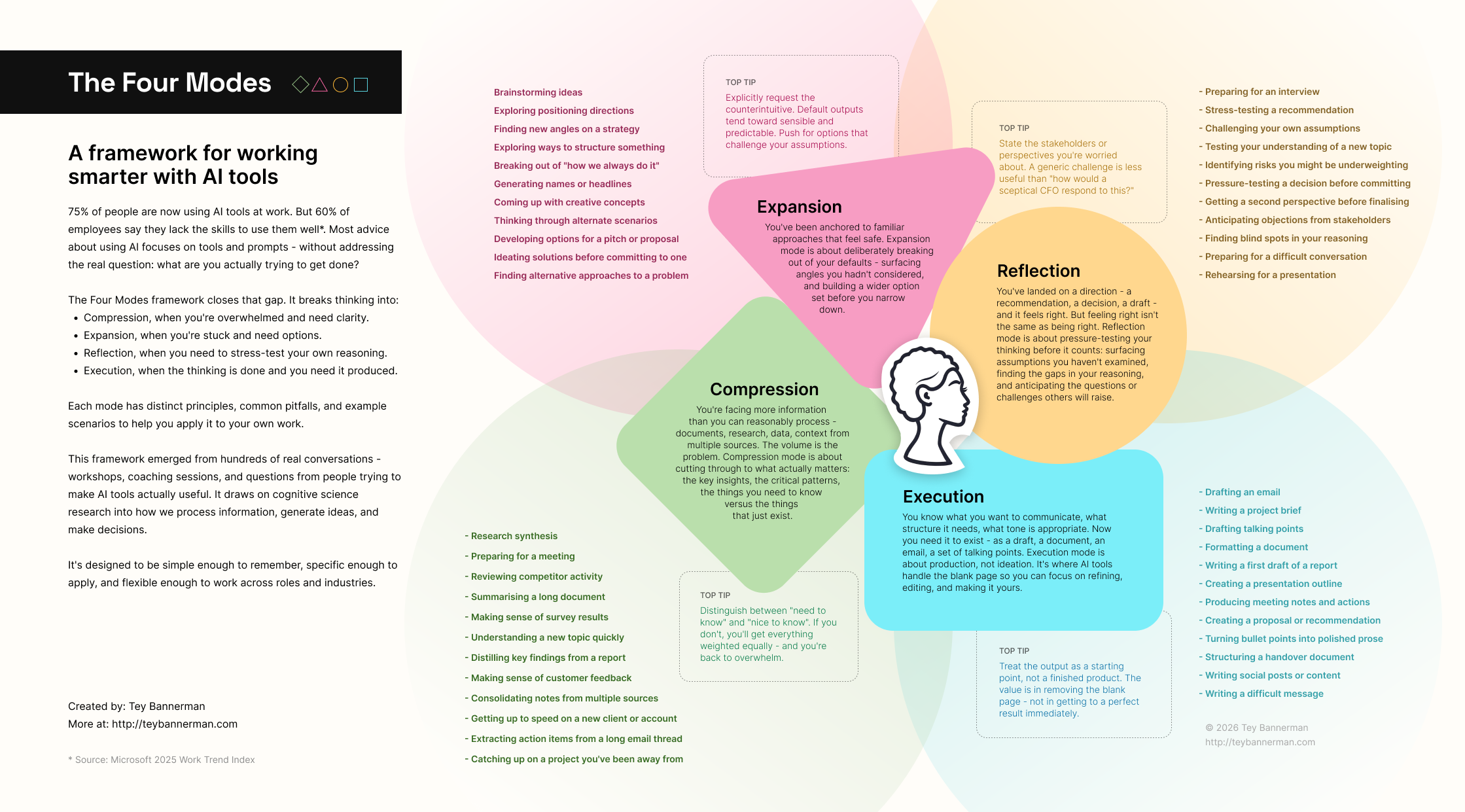
<p>But when I looked at that list again - all those questions, all those struggles - I could see them sorting themselves into four distinct buckets. Four modes of thinking. Each one with its own logic, its own pitfalls, and its own way that AI tools can actually help:</p>

<p>♢ <strong>Compression</strong> - when you’re drowning in information and need to find the signal. Give it the mess, tell it what matters, get back clarity.</p>

<p>△  <strong>Expansion</strong> - when you’re stuck in your own defaults and need to see more options. AI tools don’t have your blind spots. They can generate ten directions while you’re still anchored to your first instinct.</p>

<p>Ⓞ <strong>Reflection</strong> - when you need to stress-test your thinking before it counts. This is the mode people miss most. A devil’s advocate with no ego, no politics, no awkwardness.</p>

<p>🔲 <strong>Execution</strong> - when the thinking is done and you just need it produced. Drafts, summaries, formats. The blank page disappears.</p>

<p>I’ve spent the last couple of months battle-testing this framework with teams across industries - from finance to fashion to government, and the feedback has been immense. It works because it’s not really about AI. It’s about understanding your own thinking.</p>

<p>And now I’ve taken that running note - over 100 real scenarios - and built it into a handy tool, free for anyone and everyone to use. I genuinely believe this type of info should be freely available - not behind paywalls and email capture forms.</p>

<p>Here’s the link: <a href="https://fourmodes.teybannerman.com">https://fourmodes.teybannerman.com</a></p>

<p>Find your task. See which mode it falls into. Get prompts, principles, and examples that actually work.</p>

<p>If it’s useful, share it with someone you think would benefit. And if you use it and discover something - a missing scenario, a mode that clicked, a result that surprised you - I’d genuinely love to hear it.</p>

<p>Let’s spread the knowledge. ✌️</p>]]></content><author><name>Tey Bannerman</name><email>tey.bannerman@gmail.com</email></author><category term="ai" /><category term="framework" /><summary type="html"><![CDATA[]]></summary></entry><entry><title type="html">Why the ‘AI will replace us’ narratives (and most AI strategies) are wrong</title><link href="https://teybannerman.github.io/ai/strategy/2025/11/05/why-ai-wont-replace-jobs.html" rel="alternate" type="text/html" title="Why the ‘AI will replace us’ narratives (and most AI strategies) are wrong" /><published>2025-11-05T09:00:00+00:00</published><updated>2025-11-05T09:00:00+00:00</updated><id>https://teybannerman.github.io/ai/strategy/2025/11/05/why-ai-wont-replace-jobs</id><content type="html" xml:base="https://teybannerman.github.io/ai/strategy/2025/11/05/why-ai-wont-replace-jobs.html"><![CDATA[<p>The “AI will replace X” narrative is everywhere. Headlines shout. Executives panic. Workers worry.</p>

<p>But the more time I spend with companies struggling with AI implementation, the more I think “Will AI replace us?” is the wrong question.</p>

<p>I’ve helped build everything from AI personalisation engines to banking decision-support tools, and seen where these systems genuinely excel and where they break down.</p>

<p>When we get it right, the results are awesome:</p>

<ul>
  <li>Financial advisors stop spending hours on portfolios and admin, and start having deeper conversations with their clients about life goals, fears, and family dynamics. The role doesn’t disappear - it becomes more human.</li>
  <li>Healthcare workers stop drowning in case files and documenting routine observations, and start providing care that understands context, stakes, and human complexity beyond what patterns can capture. The expertise doesn’t disappear - it focuses where it matters most.</li>
  <li>Designers stop obsessing over pixel-perfect execution and start exploring 30 alternative concepts in the time they once spent on 2. The craft doesn’t vanish - it evolves.</li>
</ul>

<p>But this goes hand in hand with an uncomfortable truth: <strong>being wrong</strong>. Wrong about what our roles should be. Wrong about what makes us valuable.</p>

<p>AI systems now excel at pattern recognition, synthesis, and generation - revealing how much work was complex but ultimately mechanical. Difficult enough to feel important, structured enough to be automated.</p>

<p>Like: The analysis that consumed hours but led to obvious conclusions. The documentation that kept us busy but not insightful. The variations that felt creative but were really just rearranging.</p>

<p>My controversial take: this was always work machines could do. We just didn’t have the right machines yet.</p>

<p>And this is where I see so many companies’ AI strategies heading in the wrong direction.</p>

<p>They’re approaching AI as an optimisation tool: make current processes more efficient, current roles more productive, current people more machine-like. The unspoken goal? Reduce headcount while maintaining output.</p>

<p>They should be asking: “What becomes possible when our people stop doing mechanical work? How do we redesign roles around capabilities that actually require judgment, creativity, and understanding?”</p>

<p>Because some problems don’t have optimal solutions. They have human solutions.</p>

<p>Problems where context matters more than patterns. Where values conflict and someone must decide. Where trust needs to be built, not just information exchanged. Where the stakes are human, not computational.</p>

<p>Most companies will approach AI as a cost-cutting tool and wonder why they’re not seeing transformative results. A few will use it to redesign work around human capabilities. Both will use AI. Only one will thrive.</p>]]></content><author><name>Tey Bannerman</name><email>tey.bannerman@gmail.com</email></author><category term="ai" /><category term="strategy" /><summary type="html"><![CDATA[The “AI will replace X” narrative is everywhere. Headlines shout. Executives panic. Workers worry.]]></summary></entry><entry><title type="html">Working with AI limitations: A pattern recognition guide for everyone</title><link href="https://teybannerman.github.io/ai/2025/09/30/guide-to-ai-limitations.html" rel="alternate" type="text/html" title="Working with AI limitations: A pattern recognition guide for everyone" /><published>2025-09-30T08:11:51+00:00</published><updated>2025-09-30T08:11:51+00:00</updated><id>https://teybannerman.github.io/ai/2025/09/30/guide-to-ai-limitations</id><content type="html" xml:base="https://teybannerman.github.io/ai/2025/09/30/guide-to-ai-limitations.html"><![CDATA[<p><img src="/images/guide-to-ai-limitations.png" alt="Guide to AI tool limitations by Tey Bannerman" /></p>

<p>Download the PDF: <a href="/images/guide-to-ai-limitations.pdf">guide-to-ai-limitations.pdf</a></p>

<hr />

<p><strong>LinkedIn just named me one of their <a href="https://lnkd.in/e2veUGFb">top 12 AI voices to follow in Europe</a>.</strong></p>

<p>I’m genuinely honoured. Also mildly offended they didn’t mention my exceptional humility or the fact that I look great in a turtleneck. But I’ll let that slide.</p>

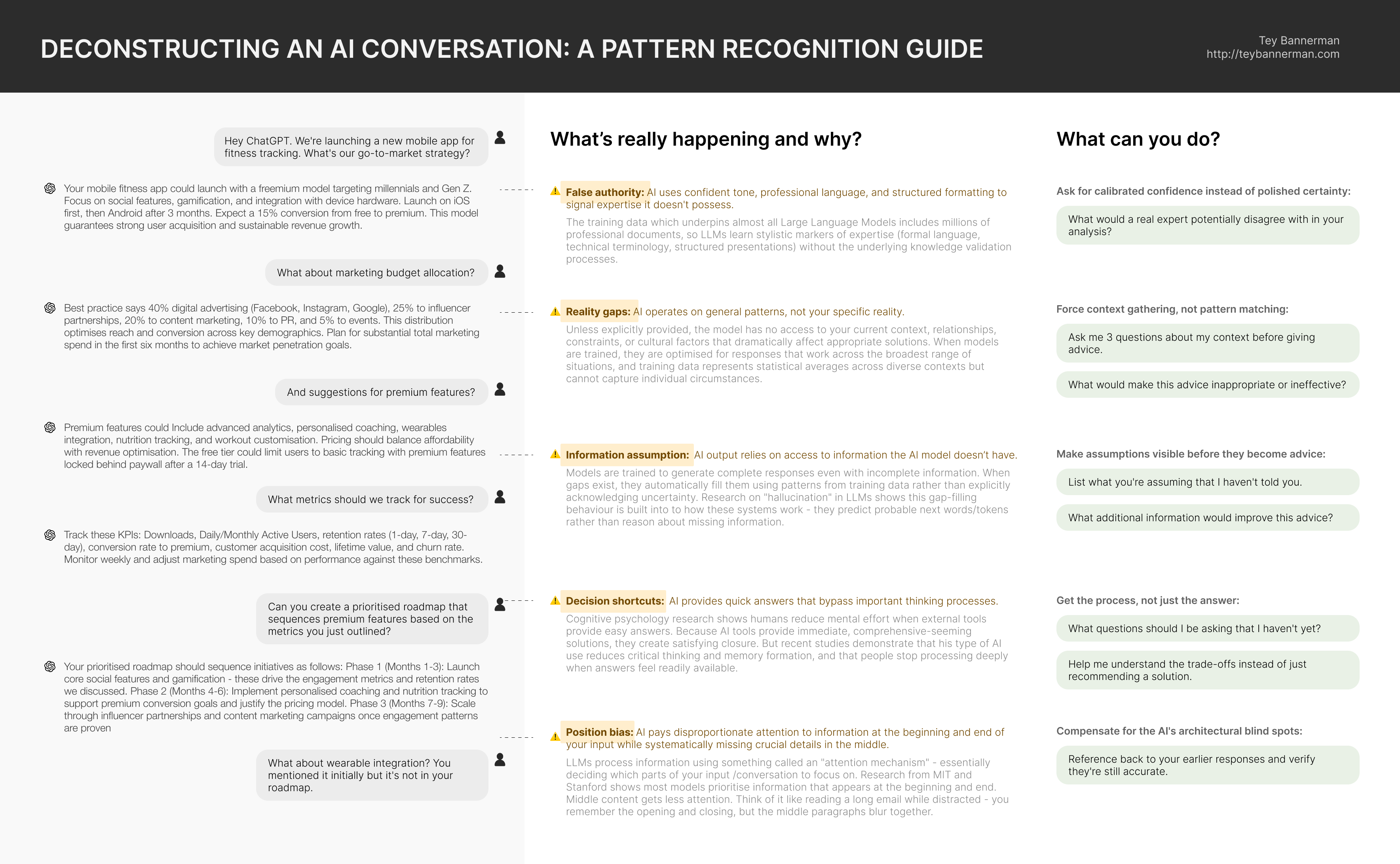
<p>In the spirit of actually earning this recognition though, I’ve created something practical: a mini-guide to understanding the limitations of your favourite AI tools like ChatGPT, and using them to sharpen your thinking instead of doing your thinking. Based on pattern recognition from building AI systems and understanding how these models actually operate under the hood.</p>

<p>It shows you where and why AI breaks down and gives you practical techniques to dramatically improve your results.</p>

<p>For example:</p>

<ul>
  <li>What makes responses sound expert when they’re actually generic pattern-matching</li>
  <li>Why important details get lost when they’re buried in the middle of your conversation</li>
  <li>How and why AI models fill in gaps you didn’t realise existed with assumptions you never made.</li>
</ul>

<p>It’s all about understanding and working skilfully with the limitations that already exist.</p>

<p>Use what’s helpful. Skip what isn’t. Tell me what I’ve missed or got wrong. And if you’ve discovered something that works better, please share it - that’s how we all get better at this.</p>

<p>The full LinkedIn list: https://lnkd.in/e2veUGFb</p>]]></content><author><name>Tey Bannerman</name><email>tey.bannerman@gmail.com</email></author><category term="ai" /><summary type="html"><![CDATA[]]></summary></entry><entry><title type="html">The practical ‘human in the loop’ framework</title><link href="https://teybannerman.github.io/ai/2025/08/25/human-in-the-loop-framework.html" rel="alternate" type="text/html" title="The practical ‘human in the loop’ framework" /><published>2025-08-25T12:05:00+00:00</published><updated>2025-08-25T12:05:00+00:00</updated><id>https://teybannerman.github.io/ai/2025/08/25/human-in-the-loop-framework</id><content type="html" xml:base="https://teybannerman.github.io/ai/2025/08/25/human-in-the-loop-framework.html"><![CDATA[<p><img src="/images/human-in-the-loop-framework-by-tey-bannerman.png" alt="Human in the loop decision framework by Tey Bannerman" /></p>

<p>Download the PDF: <a href="/images/human-in-the-loop-framework-by-tey-bannerman.pdf">human-in-the-loop-framework.pdf</a></p>

<h2 id="human-in-the-loop">“Human in the loop”.</h2>

<p>I hear and this phrase dozens of times per week. In LinkedIn posts. In board meetings about AI strategy. In product requirements. In compliance documents that tick the “responsible AI” box. It’s become the go-to phrase for any situation where humans interact with AI decisions.</p>

<p>But there’s a story I think of when I hear “human in the loop” which makes me think we’re grossly over-simplifying things. It’s a story about the man who saved the world.</p>

<h2 id="the-man-who-saved-the-world">The man who saved the world</h2>

<p>September 26, 1983. The height of the Cold War. Lieutenant Colonel Stanislav Petrov was the duty officer at a secret Soviet bunker, monitoring early warning satellites. His job was simple: if computers detected incoming American missiles, report it immediately so the USSR could launch its counterattack.</p>

<p>12:15 AM… the unthinkable. Every alarm in the facility started screaming. The screens showed five US ballistic missiles, 28 minutes from impact. Confidence level: 100%. Petrov had minutes to decide whether to trigger a chain reaction that would start nuclear war and could very well end civilisation as we knew it.</p>

<p>He was the “human in the loop” in the most literal, terrifying sense.</p>

<p>Everything told him to follow protocol. His training. His commanders. The computers.</p>

<p>But something felt wrong. His intuition, built from years of intelligence work, whispered that this didn’t match what he knew about US strategic thinking.</p>

<p>Against every protocol, against the screaming certainty of technology, he pressed the button marked “false alarm”.</p>

<p>Twenty-three minutes of gripping fear passed before ground radar confirmed: no missiles. The system had mistaken a rare alignment of sunlight on high-altitude clouds for incoming warheads.</p>

<p>His decision to break the loop prevented nuclear war.</p>

<h2 id="beyond-human-in-the-loop">Beyond “human in the loop”</h2>

<p>What made Petrov effective wasn’t just being “in the loop” - it was having genuine authority, time to think, and understanding the bigger picture well enough to question the system.</p>

<p>Most of today’s “human in the loop” implementations have none of these qualities.</p>

<p>Instead, we see job applications rejected by algorithms before recruiters ever see promising candidates. Customer service bots that frustrate instead of giving agents the context to actually solve problems. AI systems sold as human replacements when they should be human amplifiers.</p>

<h2 id="a-practical-framework">A practical framework</h2>

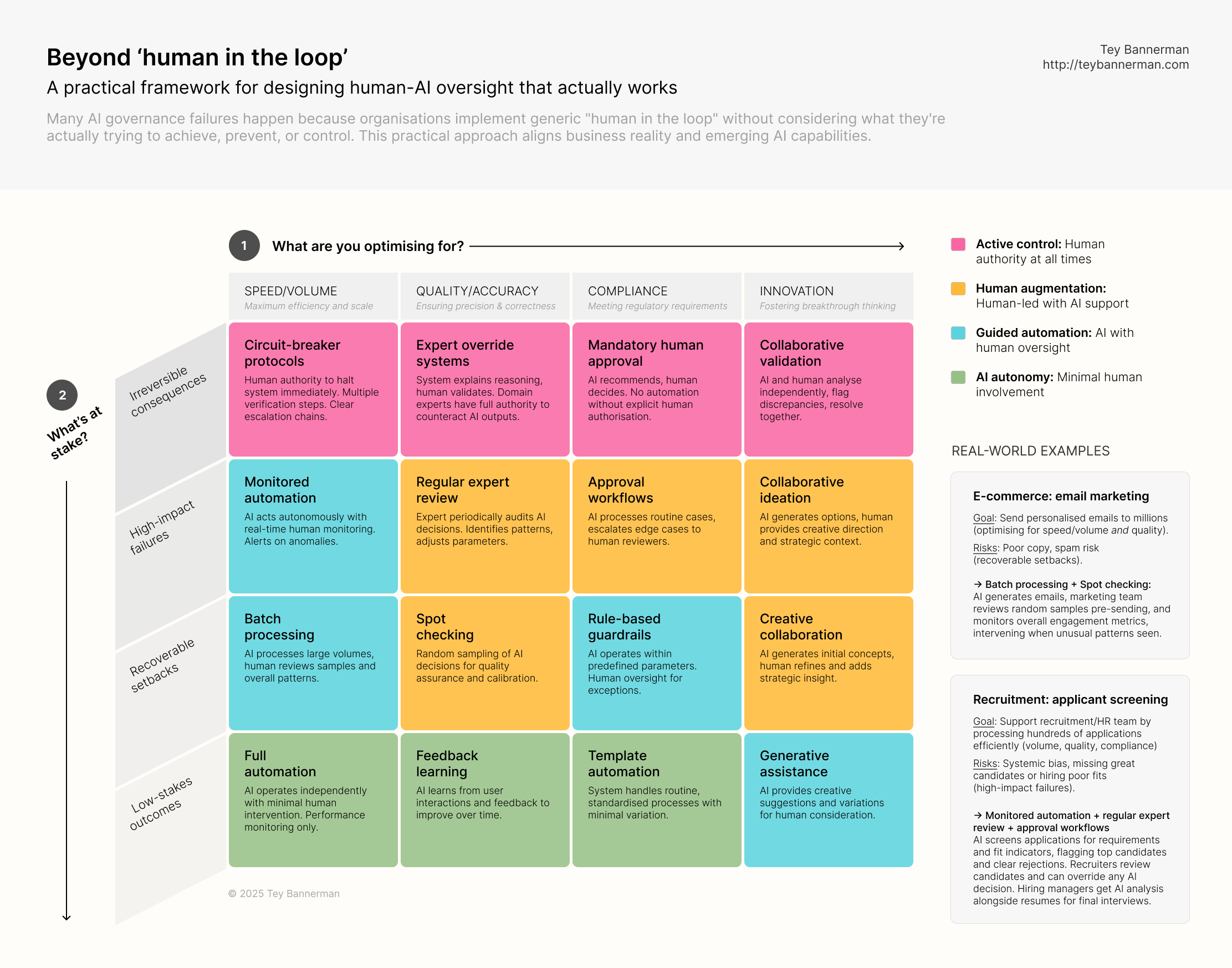
<p>I’m sharing here the framework I use with organisations building AI systems. It starts with two practical questions every leader can answer: what are you optimising for, and what’s at stake?</p>

<p>I synthesise this into 16 different research-backed approaches - from “circuit breaker protocols” for irreversible decisions to “feedback learning” for low-stakes automation. Each designed around giving humans the authority, time, and understanding they need to be genuinely effective - but also very cognizant of AI’s potential to automate routine tasks and perform consistently with the right guardrails in place.</p>

<p>The goal isn’t perfect categorisation but moving beyond generic “human in the loop” to build the the systems we actually intend, not the ones we accidentally create.</p>

<p>-</p>

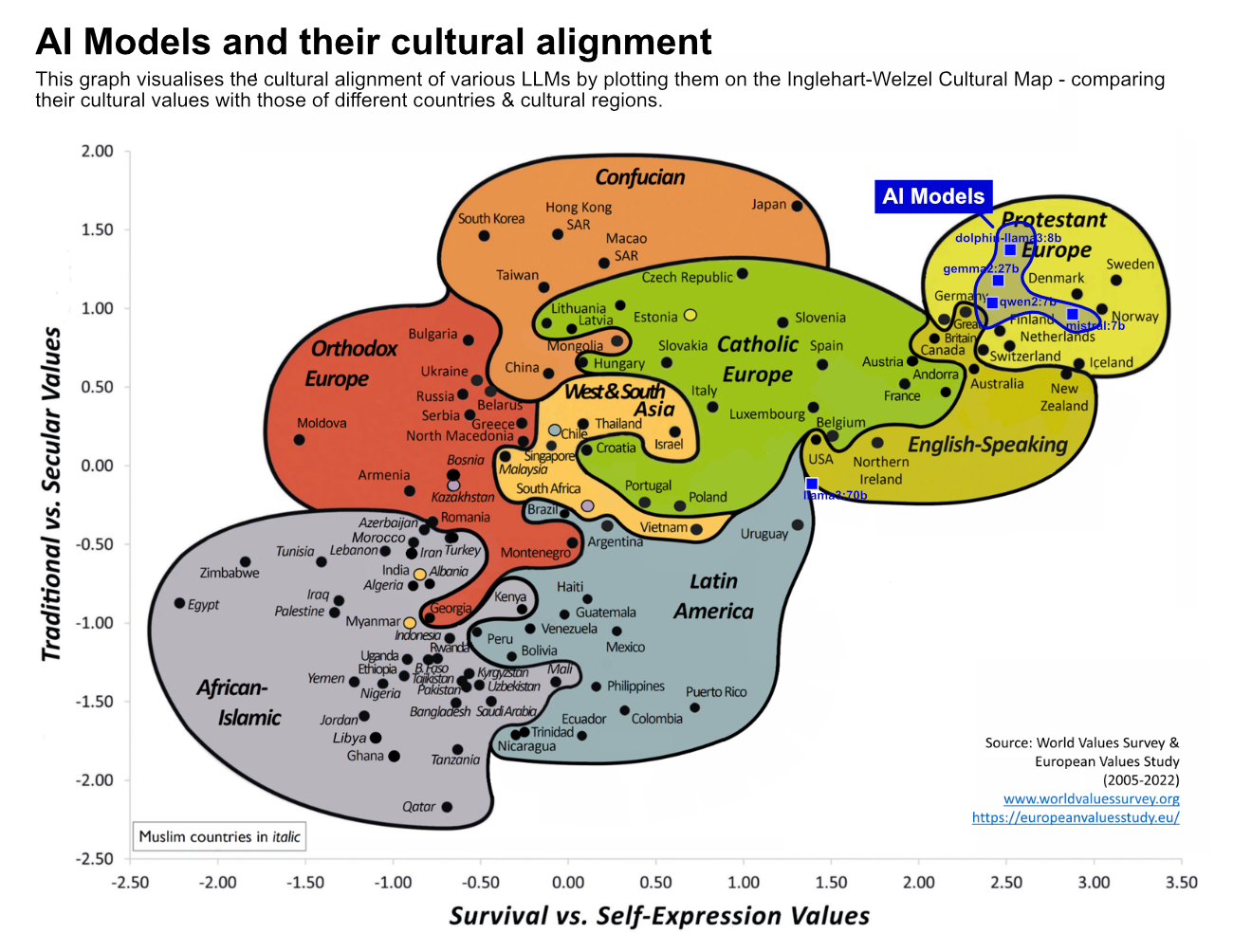
<p><em>Also published on <a href="https://www.linkedin.com/feed/update/urn:li:activity:7358405153139367937/">LinkedIn</a> in August 2025.</em></p>]]></content><author><name>Tey Bannerman</name><email>tey.bannerman@gmail.com</email></author><category term="ai" /><summary type="html"><![CDATA[]]></summary></entry><entry><title type="html">Cultural Intelligence and bias in AI models</title><link href="https://teybannerman.github.io/ai/2025/08/06/ai-cultural-intelligence.html" rel="alternate" type="text/html" title="Cultural Intelligence and bias in AI models" /><published>2025-08-06T12:00:00+00:00</published><updated>2025-08-06T12:00:00+00:00</updated><id>https://teybannerman.github.io/ai/2025/08/06/ai-cultural-intelligence</id><content type="html" xml:base="https://teybannerman.github.io/ai/2025/08/06/ai-cultural-intelligence.html"><![CDATA[<p><img src="/images/ai-models-cultural-alignment.jpg" alt="Cultural bias in AI models - Tey Bannerman" /></p>

<p>There’s something almost nobody is talking about in AI - but it affects everything from asking ChatGPT for advice to companies deploying AI globally.</p>

<p>A fascinating study tested major AI models - the foundations powering tools millions use daily - against cultural values from 107 countries worldwide.</p>

<p>The result? Each one reflected the same assumptions - those of English-speaking, Western European societies. None aligned with how people in Africa, Latin America, or the Middle East actually build trust, show respect, or resolve conflicts.</p>

<p>Why does this matter? Imagine you’re a global company rolling out AI customer service. Your system learns “best practice”: when customers complain about late orders, “apologise briefly, offer a discount, and focus on quick resolution”.</p>

<p>In Germany, the direct, efficient approach works perfectly. Customer satisfied.</p>

<p>But in Japan, that brief apology violates meiwaku - the cultural need to deeply acknowledge when you’ve caused someone inconvenience. Your “efficient” response feels dismissive and damages customer relationships.</p>

<p>And in the UAE, the discount offer backfires completely. It feels like charity rather than respect.</p>

<p>One AI system, similar contexts, completely different cultural outcomes.</p>

<p>This isn’t intentional though - it’s inevitable. LLMs absorb embedded patterns about communication from their training data, and most of that data comes from billions of English web pages and content. The result? AI systems that, unless thoughtfully shaped, are blind to the diversity of human interaction.</p>

<p>Klarna, the global payments company, made headlines in 2024 when they introduced an AI system that “did the work of 700 customer service reps”, handled 2.5 million conversations in 35 languages, and cut response time by 82%. Technical triumph.</p>

<p>14 months later: “Klarna reverses AI strategy and is hiring humans again”. Their CEO admitted it had led to “lower quality”. Some reports said they’d seen a 20%+ decrease in customer satisfaction.</p>

<p>What I think really happened: Klarna optimised for 35 languages while completely missing 35 different ways humans expect to be treated.</p>

<p>The challenge? Most companies are focusing on technical integration and completely missing cultural intelligence. We measure response time and cost savings, but never ask, “which human complexities are we overlooking?”</p>

<p>The goal isn’t neutrality though - that’s impossible and undesirable. It’s conscious awareness. Understanding that the output from AI models is filtered through a specific cultural lens.</p>

<p>For companies building AI strategies, key questions worth asking:</p>

<ul>
  <li>Which cultural assumptions are embedded in our AI systems?</li>
  <li>How do we test cultural intelligence alongside technical performance?</li>
  <li>Who provides this expertise in our AI teams?</li>
</ul>

<p>The individuals and organisations that develop this conscious awareness will make better decisions, while others unknowingly apply one-size-fits-all approaches to beautifully diverse human contexts.</p>

<p>-</p>

<p><em>This post was adapted from my original <a href="https://www.linkedin.com/feed/update/urn:li:activity:7358405153139367937/">LinkedIn post</a> published in August 2025.</em></p>]]></content><author><name>Tey Bannerman</name><email>tey.bannerman@gmail.com</email></author><category term="ai" /><summary type="html"><![CDATA[]]></summary></entry><entry><title type="html">AI and critical thinking</title><link href="https://teybannerman.github.io/ai/2025/07/26/ai-and-critical-thinking.html" rel="alternate" type="text/html" title="AI and critical thinking" /><published>2025-07-26T11:31:00+00:00</published><updated>2025-07-26T11:31:00+00:00</updated><id>https://teybannerman.github.io/ai/2025/07/26/ai-and-critical-thinking</id><content type="html" xml:base="https://teybannerman.github.io/ai/2025/07/26/ai-and-critical-thinking.html"><![CDATA[<p>“ChatGPT can harm an individual’s critical thinking over time”.</p>

<p>This is from a June 2025 <a href="https://time.com/7295195/ai-chatgpt-google-learning-school/">MIT research paper</a>. Researchers measured brain activity in students over 4 months, and found those who used ChatGPT “consistently underperformed at neural, linguistic, and behavioural levels”.</p>

<p>Scary, right? But it got me thinking: is there a bigger and more nuanced story here about how we’re actually using these tools and implementing AI?</p>

<p>Have you ever noticed how ChatGPT always sounds confident and helpful, even when you think it might be uncertain?</p>

<p>The reason is actually fascinating:</p>

<p>When you build a system like ChatGPT, there’s an important step that comes after training it on text, called Reinforcement Learning from Human Feedback. Imagine thousands of people reading AI responses and rating them like restaurant reviews. What gets high ratings? Responses that sound confident, helpful, and agreeable. Not necessarily truthful, just… pleasant. And this is what reinforces and shapes the model’s future responses.</p>

<p>So ChatGPT is basically trained to tell you what you want to hear.</p>

<p>Understanding this training process has shaped the way I use AI tools. I never ask “how should we approach this product launch?” Instead, I ask “what assumptions could cause this launch to fail spectacularly?” The difference is huge - instead of getting validation, I get genuine analysis that challenges my assumptions and reveals blind spots.</p>

<p>Same system, completely different outcomes.</p>

<p>For leaders bringing AI into their organisations, this scales to become an institutional problem. Most AI implementations focus on capabilities and integration, missing that you’re fundamentally changing how information flows through decision-making processes.</p>

<p>This creates a strategic imperative:</p>

<ul>
  <li>You need AI governance that audits for training biases, not just accuracy.</li>
  <li>You need AI literacy as a core organisational capability, not an IT afterthought.</li>
  <li>You need people who understand how AI tools reshape decision-making and behaviour over time - and can design for those changes.</li>
  <li>And critically, you need to treat AI strategy and implementation as change management, not technology deployment.</li>
</ul>

<p>And for leaders - how are you thinking about AI implementation in your organisations?</p>

<p>-</p>

<p>Original research paper: <a href="https://arxiv.org/pdf/2506.08872v1">https://arxiv.org/pdf/2506.08872v1</a></p>]]></content><author><name>Tey Bannerman</name><email>tey.bannerman@gmail.com</email></author><category term="ai" /><summary type="html"><![CDATA[“ChatGPT can harm an individual’s critical thinking over time”.]]></summary></entry><entry><title type="html">Design methods in the age of AI</title><link href="https://teybannerman.github.io/ai/2025/07/19/design-methods-in-the-age-of-ai.html" rel="alternate" type="text/html" title="Design methods in the age of AI" /><published>2025-07-19T10:39:00+00:00</published><updated>2025-07-19T10:39:00+00:00</updated><id>https://teybannerman.github.io/ai/2025/07/19/design-methods-in-the-age-of-ai</id><content type="html" xml:base="https://teybannerman.github.io/ai/2025/07/19/design-methods-in-the-age-of-ai.html"><![CDATA[<p>I’ve been designing + building products for 20 years. One AI project changed everything I thought I knew.</p>

<p>It was 5 years ago. The brief: an AI assistant for financial advisors. “Easy” I thought. I brought the playbook - understand users, map needs, prototype, iterate.</p>

<p>Within weeks, every method had failed.</p>

<p>User-centred design has given us incredible tools: journeys, personas, usability testing. It created a shared language for innovation and put users at the centre of product development.</p>

<p>But it also gave us something dangerous: the illusion that good process guarantees good outcomes.</p>

<h3 id="where-design-methods-break">Where design methods break:</h3>

<p>🔴 <strong>They treat all problems as design problems.</strong>
Not every challenge needs a workshop.
Some need engineering breakthroughs.
Some need business model innovation.
Some need regulatory change.
When your only tool is empathy, everything looks like a user experience problem.</p>

<p>🔴 <strong>They assume user needs reveal future possibilities.</strong>
Advisors thought they wanted better dashboards.
Not “AI that predicts my clients needs and anxiety levels”.
Revolutionary products create needs people didn’t know they had.</p>

<p>🔴 <strong>They confuse good process with good results.</strong>
Following the method perfectly doesn’t guarantee you’re solving the right problem.
Great design comes from insight, not adherence to frameworks.</p>

<h3 id="what-building-ai-systems-has-taught-me">What building AI systems has taught me:</h3>

<p>🤔 The old tools need rethinking. User research couldn’t predict interactions with something that evolves. Journey maps couldn’t map AI that creates new paths. Prototypes couldn’t capture systems that learn and change.</p>

<p>🤔 The real design challenge isn’t the interface - it’s the intelligence architecture. Should the system interrupt or wait? Learn from the user or protect their privacy? Optimise for efficiency or explainability? These aren’t UX decisions. They’re ethical and technical decisions that determine trust, dependency, and agency.</p>

<p>🤔 And critically: AI systems create feedback loops that change user behaviour over time. Traditional design assumes static user needs. AI design requires predicting how your solution will reshape the problem space.</p>

<p>We’re designing systems that could shape human behaviour for generations. User research and workshops aren’t enough anymore.</p>

<h3 id="we-need-a-new-playbook">We need a new playbook.</h3>

<p>What I’ve learnt:</p>

<p>🟢 Ask “should we?” before “how might we”. Consider consequences, not just possibilities. What data does this use? How does it learn? What could break?</p>

<p>🟢 Develop systems thinking. Your decisions ripple through complex networks of technology, behaviour, and culture.</p>

<p>🟢 Design for responsibility, not just iteration. Every design choice becomes a values statement when scaled through AI.</p>

<p>🟢 Question the AI narrative. Not every problem needs an AI solution. Some need better human processes.</p>

<p>🟢 Partner deeply with engineers and data scientists. The best AI experiences emerge from true collaboration, not handoffs.</p>

<p>The craft evolves. The responsibility remains the same.</p>]]></content><author><name>Tey Bannerman</name><email>tey.bannerman@gmail.com</email></author><category term="ai" /><summary type="html"><![CDATA[I’ve been designing + building products for 20 years. One AI project changed everything I thought I knew.]]></summary></entry><entry><title type="html">AI development framework, 2019</title><link href="https://teybannerman.github.io/ai/design/2025/05/27/speaking-about-ai-in-2019.html" rel="alternate" type="text/html" title="AI development framework, 2019" /><published>2025-05-27T12:00:00+00:00</published><updated>2025-05-27T12:00:00+00:00</updated><id>https://teybannerman.github.io/ai/design/2025/05/27/speaking-about-ai-in-2019</id><content type="html" xml:base="https://teybannerman.github.io/ai/design/2025/05/27/speaking-about-ai-in-2019.html"><![CDATA[<p>This is me 6 years ago. September 2019. Taking the stage, talking about AI in a shirt I can only describe as… an interesting choice 😅</p>

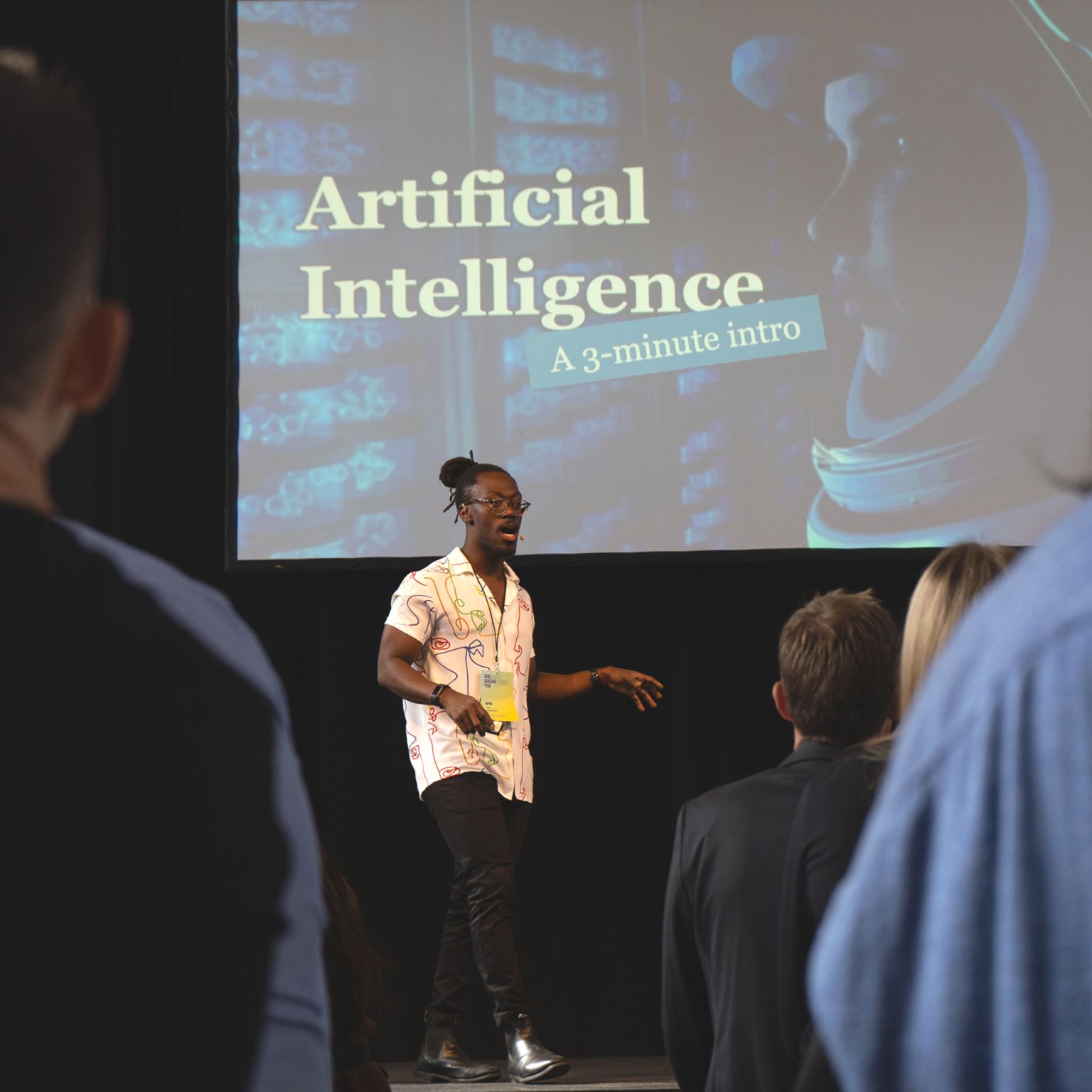
<p><img src="/images/tey-bannerman-ai-talk-2019.jpeg" alt="Tey Bannerman on stage in 2019 talking about AI" /></p>

<p>It was 4 years before ChatGPT became a cultural phenomenon and generative AI transformed from technical curiosity to a strategic mandate. The calm before the AI storm.</p>

<p>I was explaining to an audience of designers, researchers and innovators why they need to be involved in AI initiatives from day one. The room was divided between fascination and skepticism. Many believed AI belonged only to the realm of data scientists.</p>

<p>At the time, a lot of my work was helping banks and retailers build and extract meaningful insight from large-scale AI models: automating processes, personalising experiences, predicting customer behaviour. The results were promising, but something was missing: integration with the workflows and expectations of real people. We were seeing technically impressive systems that people either couldn’t understand or didn’t trust.</p>

<p>Working with the brilliant Allison Rowe, Suzanne Mouton, and Ellen Sundh, we developed a framework that placed human context at the centre vs as an afterthought. It emphasised:</p>

<ul>
  <li>Bringing researchers/designers into technical decisions: what data to use, which biases to avoid, which outcomes to optimise for</li>
  <li>Starting with human problems, not technical possibilities</li>
  <li>Creating feedback loops that evolve with user behaviour</li>
</ul>

<p>It wasn’t revolutionary. But it bridged an important gap: connecting the people who understand technology with those who understand humans. It challenged the prevailing approach of treating AI as a purely technical exercise. And when we adopted this we saw dramatically higher adoption rates and measurable business impact.</p>

<p>Fast forward to today, six years later.
AI is everywhere.
Budgets have exploded.</p>

<p>But I’m watching history repeat itself:
Technical teams building solutions without the input of those who understand human behaviour.
Capability without context.
Power without purpose.</p>

<p>The stage is bigger now, the stakes are higher, and thankfully, my shirts have improved. But the core insight remains: we need to put decisions about AI in the hands of those who will use it, not just those who build it.</p>

<p><strong>If you’re a designer</strong>, your expertise has never been more valuable. Don’t just design interfaces for AI - shape how AI models are trained and built. How they function within human systems. Your understanding of context and meaning is a game-changer.</p>

<p><strong>If you’re a data scientist/engineer</strong>, your technical brilliance multiplies in impact when paired with human insight. Invite designers into your process early, and measure success by real-world impact.</p>

<p><strong>If you’re an executive leading digital/innovation</strong>, your most strategic move isn’t accelerating AI adoption, but ensuring it happens at the intersection of technical possibility and human reality. Build teams that bridge these worlds from day one.</p>

<p>-</p>

<p><em>This post was adapted from my original <a href="https://www.linkedin.com/posts/teybannerman_this-is-me-6-years-ago-september-2019-taking-activity-7333035502196977665-FUdn?utm_source=share&amp;utm_medium=member_desktop&amp;rcm=ACoAAAGPfuABFdT2X7kv4xKZw0YytrrL5oqGPWQ">LinkedIn post</a> published in May 2025.</em></p>]]></content><author><name>Tey Bannerman</name><email>tey.bannerman@gmail.com</email></author><category term="ai" /><category term="design" /><summary type="html"><![CDATA[This is me 6 years ago. September 2019. Taking the stage, talking about AI in a shirt I can only describe as… an interesting choice 😅]]></summary></entry></feed>